
On 5 and 6 July 2026, Mumbai's airport went through one of its worst monsoon disruptions of the year. Roughly 90% of departing flights were delayed by more than an hour, nearly half of arriving flights ran late, thirteen incoming flights were diverted before eventually returning, and operations were suspended entirely for about an hour as visibility dropped and winds picked up. Four IndiGo flights were cancelled outright. Airlines including IndiGo, Air India, Akasa Air, and SpiceJet issued travel advisories warning passengers of extended wait times both on the ground and onboard.
This wasn't an unusual, one-off event — it's a fairly representative sample of what Mumbai's June-through-September monsoon does to air travel most years, and 2026 has been no exception. What made this particular spell notable was less the disruption itself than how it unfolded on the ground: roads across the city, including well-known arterial routes through Andheri, became genuinely difficult to navigate at exactly the moment travellers most needed a predictable journey to the airport.
For anyone booking a hotel near Chhatrapati Shivaji Maharaj International Airport during this stretch of the year, the usual advice — check the star rating, compare amenities, look at the reviews — misses the one factor that actually determines whether your trip goes smoothly: how far you actually have to travel between your hotel and the airport when the city's roads stop cooperating.
This Isn't a One-Off — It's a Recurring Annual Pattern
Mumbai's monsoon-season disruption isn't a freak event tied specifically to 2026. It's a structural reality of the city's geography and infrastructure that repeats, in some form, every single year between June and September. Heavy rainfall concentrated into short windows, ageing stormwater drainage in a dense coastal city, and an airport with a genuinely constrained runway layout combine to produce broadly the same pattern annually — flight delays cluster around the heaviest rain events, certain roads flood reliably, and travel planning that ignores this ends up more stressful than it needs to be.
The specific dates and rainfall totals change year to year, but the underlying vulnerability doesn't. That's actually useful information for planning purposes: if you know a pattern repeats reliably, you can plan around it reliably too, rather than treating each monsoon season's disruption as a surprise.
What Actually Happened This Monsoon Season
Mumbai's 2026 monsoon arrived on 24 June, roughly two weeks later than usual, and it made up for lost time quickly. By early July, the city was dealing with rainfall exceeding 200mm in under twelve hours in some locations — a volume that overwhelms stormwater drainage almost anywhere, let alone in a dense, low-lying coastal city.
The consequences on 5-6 July specifically were well documented: waterlogging at Lokmanya Tilak Terminus in Kurla, an official IndiGo travel advisory warning of extended ground and onboard wait times, and airport operations suspended for roughly an hour due to poor visibility and gusty winds. Emergency teams were deployed across the city to manage flooding, and tree falls — a recurring monsoon hazard in Mumbai — caused genuine, tragic harm, including fatalities in Kurla and a serious incident in Bandra East.
None of this is presented to alarm anyone unnecessarily — Mumbai's monsoon is a well-known, well-documented annual reality, and the city continues to function through it. But it's precisely because this is a predictable, recurring pattern that it's worth planning around rather than discovering the hard way.
Why Andheri Specifically Is a Recurring Trouble Spot
This isn't a generic “it rains a lot in Mumbai” observation — Andheri itself is repeatedly named as one of the city's specific recurring waterlogging locations. The Andheri Subway, an underpass connecting Andheri East and West, floods reliably enough during heavy rain that it's been flagged for years as a structural drainage challenge civic authorities have acknowledged but not fully resolved. The Western Express Highway, SV Road, and New Link Road — all major routes through and around Andheri — have also been specifically named in 2026 reporting on the season's worst flooding.
For a business traveller or anyone else needing predictable transport to the airport, this matters enormously. A hotel that's genuinely a short, direct hop from the terminal sidesteps most of this exposure. A hotel that requires crossing one of these known flood-prone stretches doesn't — no matter how good its amenities are otherwise.
The Real Math: Dry-Weather vs. Monsoon Drive Times
|
Distance from Airport |
Dry-Weather Drive Time |
Monsoon Drive Time (Realistic) |
|
2–5 km (very close) |
5–10 minutes |
15–25 minutes |
|
8–12 km (moderate) |
20–30 minutes |
45–75 minutes or more |
|
15+ km (far) |
35–50 minutes |
90+ minutes, genuinely unpredictable |
These figures are illustrative rather than a precise formula — actual monsoon delays depend on rainfall intensity, time of day, and which specific roads are affected that day. But the pattern holds consistently across Mumbai's monsoon reporting: the multiplier effect on travel time grows sharply with distance, because a longer route simply has more opportunities to intersect a flooded stretch, a stalled vehicle, or a diverted road.
There's a compounding effect worth understanding too. A hotel 2–5 km away typically has more than one viable route to the airport, meaning a single flooded junction or stalled vehicle can usually be worked around with a short detour. A hotel further out is more likely to be dependent on one or two main arterial roads for the majority of the journey — exactly the kind of route named repeatedly in 2026's monsoon reporting as a recurring flood point. When that single route floods, there often isn't a comparably short alternative, which is precisely how a 30-minute dry-weather drive turns into a 90-minute ordeal rather than a merely inconvenient one.
Why Morning Departures Are Genuinely Safer During Monsoon
Aviation industry guidance for Mumbai specifically recommends morning departures over evening ones during the monsoon months. The reasoning is straightforward: delays accumulate through the day as Mumbai's constrained runway geometry struggles to clear its schedule after any weather-related slowdown, and afternoon convective thunderstorms — a distinct weather pattern from the steadier morning rain — add a second layer of disruption risk later in the day. A generous buffer of two to two-and-a-half hours before a domestic departure is considered a sensible default during this season, longer than the standard recommendation.
This has a direct implication for hotel choice: if you're building in extra buffer time for the flight itself, you don't want to also be building in uncertainty around the hotel-to-airport leg. Genuine proximity removes one entire variable from an already less predictable travel day.
What This Means for Choosing a Hotel This Season
The core argument is simple: during Mumbai's monsoon, the single biggest source of uncertainty in an airport trip isn't the flight itself — airlines and the airport are actively managing that, as the July advisories show. It's the unpredictable stretch of road between wherever you're staying and the terminal. A hotel that's a genuine 5–10 minute drive away turns that stretch into a non-issue. A hotel that requires 30, 45, or 60 minutes through flood-prone corridors turns it into the most stressful part of the trip.
What a Good Monsoon-Season Airport Hotel Should Offer
- Genuine, verifiable proximity — a specific distance and drive time, not a vague “near the airport” claim.
- A reliable, hotel-arranged airport transfer, ideally available 24 hours, removing dependence on app-based cabs during a surge caused by bad weather.
- Flexible check-in and late check-out policies, genuinely useful when a delayed or diverted flight changes your schedule at short notice.
- On-site dining with extended hours, since a monsoon-delayed traveller may arrive well outside standard restaurant hours.
- Business and meeting facilities, in case a diverted flight turns an overnight stop into an unplanned extra working day.
- A responsive, well-staffed front desk,
- Backup power and reliable Wi-Fi,
Planning Ahead If You're Booking Months in Advance
Business travel and family trips are often booked well before the actual dates, long before anyone knows what a specific week's weather will look like. If your trip falls anywhere in the June-to-September window, a few habits are worth building into the planning itself, not just the day of travel:
- Choose refundable or flexible fares where the cost difference is reasonable,
- Favour morning flights at the booking stage,
- Book accommodation close to the airport specifically for any leg of the trip involving a flight,
- Build slack into connecting plans,
What This Looks Like at Hotel Kohinoor Continental
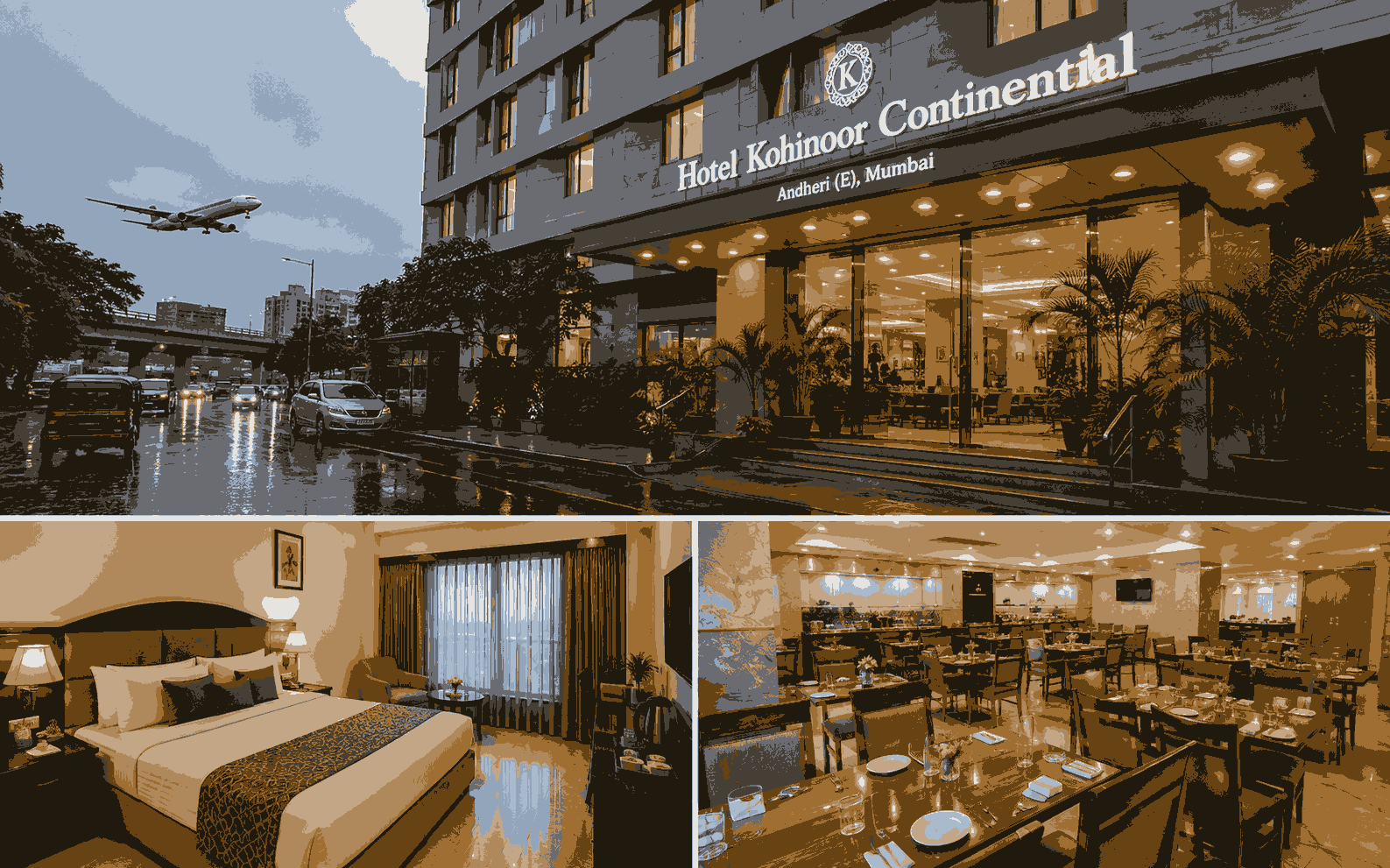
Hotel Kohinoor Continental sits directly on Andheri Kurla Road, roughly 5–10 minutes from Chhatrapati Shivaji Maharaj International Airport depending on which terminal your flight uses — a distance independently confirmed across multiple travel platforms and the hotel's own listed details. That short distance is precisely the kind of proximity that matters most during the exact weather conditions this piece has covered.
- Airport transfer:
- Dining hours:
- Business facilities:
- A recently renovated, 4-star property
This piece focuses specifically on monsoon-season considerations. For a fuller look at what makes this property a strong choice near Mumbai airport generally — room categories, business facilities, and day-to-day amenities — see our complete guide: What Makes a Good 4-Star Hotel Near Mumbai Airport.
Frequently Asked Questions
1. When is Mumbai's monsoon season, and when is it worst?
The official southwest monsoon runs June through September, with July and August typically bringing the heaviest rainfall and the highest concentration of weather-related flight delays and diversions.
2. Why does Andheri specifically flood during monsoon?
The Andheri Subway underpass and several major roads including the Western Express Highway have been repeatedly identified as recurring waterlogging hotspots, linked to structural drainage limitations that civic authorities have acknowledged but not fully resolved.
3. Is it better to fly out of Mumbai in the morning or evening during monsoon?
Morning departures are generally more reliable, since delays accumulate through the day and afternoon convective thunderstorms add an additional layer of disruption risk later on.
4. How far is Hotel Kohinoor Continental from Mumbai airport?
Approximately 5 to 10 minutes by road, depending on which terminal, according to multiple independently verified sources.
5. What should I look for in a hotel near Mumbai airport during monsoon specifically?
Genuine, verifiable proximity to the airport, a reliable hotel-arranged transfer service, flexible check-in and check-out policies, and dining hours that cover early or delayed arrivals and departures.
6. Does Mumbai's monsoon disruption happen every year, or was 2026 unusual?
It's a recurring annual pattern rather than a one-off. Mumbai's combination of heavy concentrated rainfall, ageing drainage infrastructure, and a constrained airport runway layout produces broadly similar disruption most years between June and September, even though the specific dates and severity vary.
7. Should I book refundable flights if I'm travelling to or from Mumbai during monsoon?
It's generally a sensible precaution. Weather-driven delays and cancellations are meaningfully more common during the June-to-September window, and the cost difference for a flexible fare is often worth it for the reduced risk.
Final Thoughts
Mumbai's monsoon is not a surprise — it happens every year, on a broadly predictable calendar, and it reliably disrupts the same vulnerable stretches of road and the same runway operations at the airport. What isn't predictable is which specific day it will hit hardest, or which specific route will be underwater when it does.
Choosing a hotel that's genuinely, verifiably close to the airport doesn't control the weather. It just means that when the weather does what it reliably does every July and August, the distance between your bed and your boarding gate isn't the part of the trip you have to worry about.